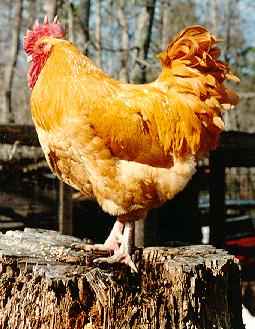
Chester the Rooster
A Fable of Chicken Bravery
by Alan Harris
|
It would not suit the requirements of high drama if our two antagonists were of like temperament, and luckily, they were not. But neither were they antithetical in temperament. I will reveal more of their respective personalities (second appeal) later as the occasions arise. By way of slightly prejudicing you, however, I will mention that Robin, for that was the elder rooster's name, was stronger, cleverer, louder, and faster than Chester, the younger rooster and also the hero of this tale. Do not think that Chester was less than a rooster in any of the anatomical respects which distinguish roosters from non-roosters. He was neither ignorant of nor inept at any deed which separates those two divisions of the animal kingdom. He was a full-blooded, full-fledged rooster in every sense of the word (including the roosting sense). Even so, alas, Chester was rather unusual, being endowed (not to say plagued) with a contemplative disposition. To prevent too-sharply-drawn contrasts in this story, I must insert prematurely the information that Robin was not totally bereft of ideas, but for now, ideas will not appear among the more noticeable or striking of his possessions.
Had Chester himself been at the opposite end of the inequality, we from our vantage point can at least speculate as to whether his reasoning might have been precisely the same. Perhaps inequality, in its pure philosophical sense, was not the focal point of Chester's thinking, and biology was. But all this is merely idle speculation. Robin was by no means boastful or contemptuous of Chester. On the contrary, he possessed all those qualities of nobility and generosity that one would expect in a rooster of his age and abilities. He was amiable toward Chester in every circumstance. In keeping with his generosity of spirit, he never attempted to start a fight with Chester. And the reverse was also true--Chester never showed any inclination to fight with Robin, though perhaps for reasons of a slightly different color. The exact color I leave to your imagination and intuition.
As a kind of poetic justice I will mention here that this hen later suffered a severe attack of egg constipation, from which she was eventually delivered of three eggs within five minutes of each other. Though she gave her eggs the most solicitous care, it happened that none of them contained the necessary germ, and alas, the shells were so thin that she soon broke the eggs with her own not inconsiderable weight, greatly to the pejoration of her fine coat of white feathers. Some of her less sympathetic companions bantered about an idea among themselves that perhaps the eggs were already rotten before their arrival, but this rumor was kept well away from the ears of its subject. I was telling of the several attitudes which Chester and the hens reserved for each other. I did not at all mean to imply that the hens, as a group, intentionally ridiculed Chester--only the one hen stooped so low. Actually, they tormented him more by simply ignoring him than if they had openly scorned him, for Chester knew that scorn is usually a thin disguise for admiration (especially among chickens), whereas to ignore is, of all responses, the most devastating and discouraging. Chester, since he was largely ignored by the hen population, and since their opinions weighed heavily upon his mind, took to secluding himself from them. At any hour of the day or night, the hens could find him brooding in his own private corner of the henhouse. I must here explain, with apologies to the more prudish reader, that among chickens in general, the roosters not only frequently visit the henhouse, but they also sleep there. But back to Chester. Some wise person has observed that the primary fruit of seclusion is the desire for more seclusion. Chester's actions demonstrated no exception to this truth, and I am afraid he had become, by the time this story takes place, no less than a hermit of chickens. Robin and the hens continued to perform the time-honored rituals of living--roosting by night, roaming and pecking and clucking by day, and suffering life's minor tragedies. I will not spread before you all of these minor tragedies, since only that portion of readers given over to the enjoyment of scandalous and sensational news articles would appreciate their inclusion. I feel that reading matter of that type has never found itself widely unread, and since as a result it is available in quantity to those who like it, I will record only those events which have artistic potential and wide significance.
The actions and speeches of our chicken characters will not go unnoticed by any means, but I will so distill them as to present to you a pure exercise in the analysis of chicken behavior, and not, to be sure, a paltry transcription of vulgar scenes and conversations. In short, I will not permit the plot (there will be a plot) to run away with itself by simply playing the part of a movie camera or a tape recorder, but will exercise selection of detail to such a degree that some sagacious critics, who may arrogantly imagine that they can do better themselves (but will not lower themselves to try it), will maintain that the plot of this story is completely subordinate to my interruptions of it. I will resist a temptation to comment upon television commercials, and force myself to begin the plot, lest our chickens die of old age before I have committed their drama to paper. A major weekly tragedy, besides the minor ones, was beginning to worry everyone in the chickenyard. This recurrent tragedy was the unfortunate death of three hens of the choicest proportions and weight on each Saturday morning. The person responsible for the deaths we will call simply the Boss of the Barnyard so that he may be protected from the talons of any indignant descendants of his victims (though these descendants, I surmise, are rather few). He effected the slaughter neatly and humanely (to avoid the word "chickenly" here) by means of two objects external to himself. One of these objects was a flat-topped tree stump about as high as his waist and located some 18 to 20 feet west of the henhouse. Rather I should say, the henhouse was located about 18 to 20 feet east of the stump, because the stump with its predecessor, the tree, long antedated the henhouse. The other of the two objects was a hand instrument commonly employed to separate limbs from a tree, but in this case used, if I may present a gruesome analogy--but no, I will not. The instrument, then, was a hatchet, which, when propelled downward by both gravity and the arm muscles of the Boss, embedded itself in the stump--but only after making a sharp and unnatural division in the hen's neck.
What I am leading up to is the rather banal observation that each chop was accompanied by much flurry and confusion on the part of the hapless, headless victim. Those hens who were lucky enough to be carrying their heads with them in the proper position after each week's massacre proceeded to use these heads in avoiding the area of the stump. Soon they began to avoid even looking at the stump, much as some humans avoid reading about executions in the newspapers. I now shift from the stump outside the henhouse to a different scene, much more agreeable and instructive. Here inside the henhouse Chester the rooster has assumed a rigid reclining posture of deep thought. In fact, he looks as if he might be in a hypnotic trance, in the darkest, most isolated corner of the building. Not many two-legged creatures, human or chicken, are inclined to waste much of their valuable time in such isolation as I have just described. We humans have found that for the purpose of amassing a small fortune (or indeed, a large one), isolated contemplation is one of the poorest devices known. And those few eccentrics who do indulge themselves in the dubious pleasure of independent and fanciful thought usually find themselves to be the worst paid in yearly salary, that universal (if meaningless) barometer of competence in all fields of endeavor. Nevertheless, perhaps you, the reader, who are no doubt a diligent worker, can remember a time when wild and disconnected ideas were somehow permitted entry into that paragon of rationality, your own brain--that one time when you were idle. If so, you can sense our hero's state of mind.
The specifics of this fantasy danger he never bothered to clarify for himself because the good feelings that arose in his thin breast due to having acted as benefactor and savior to so many fair-damsel hens entirely precluded the necessity of any details. He basked and bathed in his imaginary glory for an entire week without giving the least thought to the real world of Robin, the hens, and the henhouse. Then by degrees during the next week, he began to descend back into the cold, indifferent world of roosts, nests, and straw which surrounded him. Upon his return into reality he could sense a certain pervading nervousness among the hens. For example, they might have to peck upwards of five times at a single kernel of corn before they would hit the mark. At night the hens constantly fidgeted back and forth on their roosts, casting sleepless and suspicious glances at each other. The slightest unfamiliar noise would prompt the whole roostful of them to jump into the air, squawking and flailing their wings in utter panic, and then landing helter-skelter on the floor, on the roosts, and on each other. Sometimes there had been no noise at all, but the power of some imagination among them had provided the alarm. Noise or no noise, the flurry was the same. "The panic of one chicken spreads to the many faster than flames spread over gasoline" (old farmer's axiom). After such an episode, the hens would gather what little of their wits remained and hop back up to their roosting places, only to go through the same cycle within a few minutes. Chester, observing this anxiety, decided that perhaps his dream of danger was at the point of coming true. He could not account for the hens' case of frayed nerves without ascribing it to an external threat of some kind. A plan began to form in his mind. Perhaps he could discover the source of the hens' fright. This should not be difficult to do since he could go wherever they could (except for a certain sacred territory into which it would never be proper to affirm that the male of any animal species would be allowed to follow the female--the hens' euphemism being "the protein room," analogous to the human "powder room."
He awoke before sunrise the next morning and began to fill in the details of his plan: he would sneak outside through the henhouse door before that glorious symbol of all life, light, religious experience, hope, and charity rose in the east. He would investigate the grounds over which the chickens roamed, and perhaps he could discover that menace so greatly feared by them. True to his plan, Chester soon crept through the dark open door on tipclaws, making every effort to conceal his going, for he was not outwardly as confident of success as he was inwardly (he was in this respect the reverse of most chickens). Nevertheless, for all his fastidious precautions in the way of stealth, he was noticed by nearly every hen on the roosts. You will perhaps wonder at this, but the fact is that the hens knew that this morning was Saturday and that it would bring another Incident. They had suffered through most of the night in nervous insomnia, fidgeting and reenacting such scenes of mass hysteria as I have already described. As soon as Chester had disappeared outside the door, the hens squawked to and at each other in suspicious undertones. They all had thought that Chester was in no way connected with the slaughter of their fair sisters, but they could not account for his present mysterious actions. Soon their suspicions about him outweighed their confidence in him. Chester's going outside would have indeed surprised them had it occurred on any morning of the week, for Chester rarely ventured outside the henhouse--but for him to go out on Saturday morning was sufficient grounds for suspicion, as any hen-sized mind would aver. Outside, Chester thoroughly inspected the territory around the henhouse for groundhog dens, fox dens, or any other possible or plausible sources of danger. But he did not expect much to happen until after sunrise, when the hens would begin to forage for their first scraps. He did not have long to wait, as it happened, because the sun was already rising. Chester (an intelligent modern rooster) was not so pompous as to crow when the sun rose, as though he were somehow responsible for its return to the eastern sky. He left such foolishness to Robin, who was just now beginning to tune up.
By now the hens were deciding that their hunger exceeded their fear, and that perhaps they would rather die on a full stomach than live on an empty one. They ventured into the new morning to look for and peck at whatever it is that hens look for and peck at. But in keeping with their usual Saturday morning habit, they avoided the area of the stump. Consequently, they did not see Chester perched watchfully upon it. Suddenly one hen forgot herself for a moment and glanced at the dreaded stump through the corner of her eye. She was positioned somewhat nearer to the stump than the others, and when she saw Chester upon it, she let out an ungainly squawk (for hens are wont to squawk thus in feather-raising alarm). Other hens quickly came to see if perhaps the Boss of the Barnyard had taken her as a victim. Of course, the hens' motives for rushing toward the squawk arose entirely out of pity and concern for one of their number, and not in the least out any morbid eagerness to see a companion executed, even if that very execution might mean one less chance for their own demise that day--nothing of the sort had entered their heads, I am sure, almost. At any rate, these hens saw what their sister had seen--Chester the rooster perched steadfastly upon the very stump they had been avoiding even looking at. The variety of excited clucking and squawking was sufficient to amaze any ear.
Robin, who was by now finished with his sunrise aria, showed no inclination to take Chester's place--an act which one might expect the nobler rooster to perform. Instead, he gave out a peculiar chuckling sound, a sound very uncharacteristic of a brave, experienced rooster. At this point I will arbitrarily skip over a period of several hours without relating every incident, for, surprisingly, nothing of any consequence occurred that morning, nor most of the afternoon. You can imagine what prolonged agony the chickens were suffering, since the dreaded Incident had never before taken place later than Saturday noon. You are perhaps experiencing the same feeling, waiting for something to happen in this story. The inevitable result of any, even the slightest, deviation from normal patterns of events, however undesirable the deviant events, is that rumors will arise to account for them. The most prominent and widely-accepted rumor circulating amongst the hens was that the Boss of the Barnyard had prepared to come out to the chickenyard that morning for his weekly quota of hens, but had seen Chester sitting bravely upon the tree stump. From that distance Chester probably did appear brave, but actually he was asleep, and had been since 9 o'clock, owing to his scant sleep the night before. The Boss, respecting and perhaps fearing (thought the hens) this magnanimous gallantry, had decided not to venture into the chickenyard after all. This, please note, was merely a rumor among the hens, and I will so far infringe upon the natural order of events as to tell you that it had not the least grain of truth in it.
Because of their great commotion over Chester, none of the hens noticed that a pickup truck had backed into the chickenyard, loaded with several crates especially designed for holding chickens. The story from here forward is as sad as it is short. All the hens were quickly captured, having been taken by surprise, and the truck, driven by the Boss of the Barnyard, carried them away, leaving behind only our two roosters, Robin and Chester. The latter was still outside, and was quite surprised that he had not been captured or even chased. Soon Robin emerged from the henhouse with a long and sad look about his face (you must use your imagination). Robin had known all afternoon what would happen, which explains his mysterious comings and goings. He well knew the entire pattern of the Boss of the Barnyard's actions, for he had lived through many generations of hens. The pattern was this: when each group of hens became full-grown, the Boss would slaughter three of them each Saturday for several weeks, and on the first Saturday which saw no slaughter he would put the rest of them in crates and drive away. Chester was too young to know the pattern, having only recently arrived along with the hens just removed. Robin knew life would be tedious for some time until the next group of young pullets arrived. He was growing old, and he knew that Chester would soon replace him. He jumped onto the stump, took a deep breath, and released a sad, experienced cock-a-doodle-doo, while Chester, rather repelled by such a display of emotion, retired to the henhouse. |
 MONG THE INHABITANTS of a certain barnyard were several two-legged but not-quite-human creatures, chickens. I would guess there were about 35 of them, though I never counted them to be sure. Of these chickens, two were roosters, and they were on terms less than friendly--but also, less than hostile, I must add, for they were civilized roosters.